
Arabic
The Department of Arabic Language was established in the 2012-2013 academic year. Since then, the department has graduated cohorts of specialized students to teach Arabic language and literature in secondary schools under the Ministry of Education in the Kurdistan Region/Iraq. The department has kept pace with administrative, academic, and cultural developments, and its members have participated in most of the scientific, cultural, and social activities of the department, the college, and the university. They are committed to fulfilling their mission of developing individual and collective capabilities, enhancing students' academic competencies, and advancing their academic careers.
The college's academic staff consists of a distinguished cadre of (26) teachers in various general and sub-specialties of the Arabic language. The department's academic staff has grown to include four faculty members holding the title of Assistant Professor, (5) Assistant Professors, and (17) Assistant Professors, comprising master's and doctoral students. The number of Assistant Professors is (2), in addition to a teaching assistant with a master's degree who recently obtained the title of Assistant Professor. The department has its own building to the left of the College of Education, comprising (4) halls and (7) faculty rooms. The department is witnessing continuous growth and contributing, with God's help, to the service of the language of the Holy Qur'an and the sciences of the Arabic language. The department's foundations were updated on May 20, 2025.
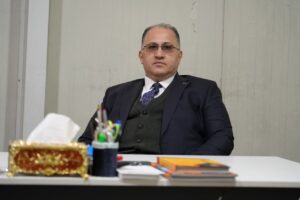
Assist. Prof. Dr. Hisham Falih Hamid
Assistant Professor Dr. Hisham Faleh Hamid, born in January 1979, holds a bachelor's degree from Baghdad, University of Iraq, College of Arts, Department of Arabic Language in 2021 AD, and a master's degree from the same university and college in 2004 AD. The thesis was (Hisham bin Ammar Al-Dhafri's Reading, a Linguistic and Grammatical Study (Master's Thesis). The second thesis: Surah Al-Qiyamah, a Stylistic Study (Thesis) because we studied within the American curriculum, and the doctorate was from the aforementioned university: and the title of the thesis (Grammatical Interpretation in Al-Durr Al-Masun by Al-Sameen Al-Halabi) and it is printed in the form of a book, which means that my general specialization is in language and precise in language and grammar.
I currently hold the position of Head of the Arabic Language Department at the College of Education, Makhmour, and Head of the Graduate Studies Division/at the College of Education, Makhmour, and Head of the Scientific Committee in the Arabic Language Department, and an editorial member, writer, and linguistic proofreader in Ru'ya Journal for Documentation and Studies, and a member of the editorial board of Al-Maaref Al-Jada'a Journal, and a member of the Linguists Association Iraqi, and advisor to the Arab Cinema Union.
The department aims to disseminate solid linguistic and literary knowledge within the framework of a modern educational environment, in order to prepare specialized educational cadres in methodical studies of Arabic language sciences and literature, and equip them with the necessary skills to apply this cognitive expertise in the fields of scientific research and educational work.
The Arabic Language Department in the College of Education also looks forward to preparing a generation that is scientifically and culturally competent, aware of the requirements of the stage. The department works to prepare teachers and researchers who take upon themselves the advancement of the scientific reality in the Kurdistan Region, and prepare specialized educational and research cadres in the Arabic language and its literature, to contribute to meeting the needs of the labor market.
It seriously seeks to keep pace with the development of academic and educational research paths and curricula to achieve international excellence standards, and develop cognitive and behavioral skills within their framework, through building concepts and taking measures to develop education at all levels in cooperation with university colleges and relevant ministries. From this mission emerge direct tasks represented in preparing and continuously training teachers, which means preparing distinguished pre-service teachers, developing them professionally during service, and promoting educational research in a way that helps produce educational knowledge and develop policies and programs that serve society and its development.
The department also seeks to conduct serious research and studies in the field of Arabic language and human knowledge in service of the local community regarding the Arabic language and its literature through activities, lectures, seminars, and conferences that the department holds or participates in.
The department also seeks to be a distinguished global reference in linguistic and cultural studies, and to supply the local labor market with specialists with effective academic and skill competencies in the field of teaching Arabic to non-native speakers.
VisionThe Arabic Language Department, as part of the educational and academic research institution, seeks to occupy its prestigious academic position relative to similar educational institutions and departments in the local and global environment. It aspires to distinguish itself from similar institutions in the local environment, and then strive to achieve progress at intemational academic levels.
The Arabic Language Department in the College of Education also looks forward to creating an effective educational and pedagogical environment that contributes to building teaching generations capable of bearing responsibility and leading the educational process; creating research generations capable of achieving remarkable progress in the field of scientific research, in a way that contributes to driving the wheel of development in the academic institution, and creating an effective educational and pedagogical structure, and employing advanced data and capabilities to build teaching generations capable of bearing responsibility, and achieving remarkable accomplishment in the field of scientific research in a way that contributes to driving the wheel of education in the academic institution, and achieving excellence in providing distinguished scientific, educational and pedagogical services in the Arabic language and its literature, especially since the Arabic language is a global language that occupies a prestigious position among the world's languages.
Learning outcomes must be consistent with the department's vision, mission, and objectives. These outcomes include proficiency in the Arabic language at its various levels, an understanding of grammatical and morphological rules, the ability to conduct literary and critical analysis, and research, writing, and translation skills. They also include the ability to teach, proofread, and work in the media and journalism fields :
- Linguistic Skills
- Comprehensive Mastery of the Arabic Language
- Proficiency in phonetics, morphology, syntax, and semantics, in addition to writing, reading, speaking, and listening skills.
- Knowledge of critical approaches, understanding various critical approaches, and applying them to literary texts.
- Familiarity with various literary trends and their development.
- . Research Skills: The ability to conduct scientific research in the field of language and literature, and the ability to use various sources in research.
- The ability to teach at various educational levels.
- Work in the media and journalism fields, including journalistic writing, editing, and media. Working in the field of writing, editing, and writing and editing articles.
- Ability to proofread various articles and texts
The Department of Arabic, College of Education Makhmour, University of Salahaddin - Erbil, offers a comprehensive four-year Bachelor of Science in Arabic program. This program is designed to provide students with a solid foundation in the Arabic sciences, combining theoretical knowledge with practical skills to prepare graduates for careers in education, scientific research, and related fields.
The undergraduate curriculum covers a wide range of Arabic disciplines and has been reorganized into Tow main areas, each comprising several subjects:
Language Arabic and Literature, Such as grammar, morphology, pre-Islamic, Islamic, Umayyad and Abbasid literature, Arabic rhetoric, prosody and literary criticism.
In addition to the core science subjects, the curriculum also includes a range of teaching materials to support teaching competencies:
Students participate in both lectures and laboratory sessions, ensuring adherence to the curriculum. A balanced approach to learning that focuses on applying scientific concepts to real-world scenarios.
Program learning outcome
Learning OutcomesMaster's program graduates will be able to:
Demonstrate a comprehensive and advanced understanding of Arabic linguistic structures, literary traditions, and cultural contexts.
Apply advanced analytical methods to the study of Arabic texts, oral traditions, and linguistic phenomena.
Design and implement research projects related to the Arabic language and literature, using appropriate scholarly methods and ethical standards.
Critically evaluate Arabic literary works within historical, social, and cultural contexts.
Communicate effectively in both Arabic and academic languages through professional writing, translation, and oral presentations.
Demonstrate cultural sensitivity, scholarly integrity, and ethical responsibility in research and cultural heritage preservation work.
Collaborate effectively in multidisciplinary teams to address the challenges of documenting Arabic and preserving literary heritage.
Contribute to the development of Arabic language teaching and cultural programs through innovation, leadership, and ongoing scholarly research.
The Arabic Language Programs in the Arabic Language Department offer intensive courses. Each course is designed to provide students with practical skills and a comprehensive understanding of various Arabic disciplines. Below is a detailed list of courses offered in the programs :
Arabic Language Program - First Semester
Arabic Language Program Semester Second Semester
Arabic Language Program -Third Semester
Arabic Language Program -Fourth Semester
- Zankoline (government-funded) Study
- Description: This option provides free tuition for students who meet the eligibility criteria and are accepted through the general centralized admission system, known as "Zancoline."
- Eligibility:
- Applicants must meet the academic requirements of the Ministry of Higher Education and Scientific Research.
- Selection is competitive and based on high school scores, particularly in scientific subjects.
- Benefits:
- Exemption from tuition fees.
- Access to complete university services and facilities.
- Parallel Study (Self-Funded)
- Description: This option allows students who do not secure a Zankoline seat to pursue their studies by paying a tuition fee.
- Tuition Fee: 3,000,000 IQD per year.
- Eligibility:
- Students must meet the minimum academic requirements for admission to the Arabic program.
- This option provides additional opportunities for students to catch up on the Zankoline criteria.
- Benefits:
- Access to the same high-quality education, resources, and facilities as Zancoline students.
- Students can pursue their academic goals without being limited by centralized admission quotas.
- Academic Qualifications:
- Minimum GPA as determined by the Ministry of Higher Education.
- Application Process:
- Apply through the centralized admission system for Zankoline
- Submit required documents, including transcripts, identification, and certificates.
- Language Proficiency:
- Basic proficiency in English, as several courses are delivered in English.
- Arabic language proficiency is also beneficial.
Graduate Employability
Job Opportunities for GraduatesThe Arabic Language Department was established in 2012. Initially, the number of students was 50 and 4 lecturers. However, the number of students and lecturers has increased significantly in subsequent years. The department currently has 26 lecturers and 250 students. The academic staff includes various academic ranks, ranging from assistant professors to full professors. The academic staff consists of 21 male lecturers and 6 female lecturers. A large number of students have completed their postgraduate studies (master's and doctoral degrees) in this department. The department places great emphasis on science and education, having trained many teachers at the Ministry of Education in the latest teaching and scientific methods. Graduates of the Arabic Language Department teach Kurdish language and literature in schools affiliated with the Ministry of Education in the Kurdistan Region. The Arabic Language Department has also placed great emphasis on cultural activities since its establishment, holding numerous conferences and seminars annually. Numerous activities related to Arabic language, literature, and culture are held annually, showcasing the talents of the department's students.
The Arabic Language Department also offers other scholarly activities, including authoring books and conducting research on all prominent topics related to Arabic language, literature, and culture.
Other scholarly activities include comparative work in literature and linguistics. Linguistics includes comparisons with English, and literature includes comparisons between Arabic and Kurdish literature.
Academic Advising
The program is structured to include 120 ECTS over two academic years: Coursework (60 ECTS): Advanced topics in Arabic language and literature tailored to the student's area of specialization. These may include advanced Arabic grammar and syntax, literary theory and criticism, Kurdish historical linguistics, translation methodology, research methods in literary studies, and comparative Arabic literature. Research Thesis (60 ECTS): An independent research project in the field of Arabic language or literature, culminating in a thesis defense. The thesis demonstrates the student's ability to apply theoretical knowledge to real-world linguistic or literary issues through systematic investigation and original scholarship.
Internship Opportunities
Graduates are qualified to work in diverse professional settings, such as:
Career Services
Graduates of the Department of Arabic Language and Literature are prepared to serve as highly qualified teachers of Arabic language and literature. Here are the key points outlining the services they offer, potential workplaces, and expected learning outcomes:
Services Offered to Society and Individuals